

Trading Card Game Rulebook

Aim of the Castle Wars TCG is to reduce your enemy’s castle health to 0 or make an enemy player unable to draw a card when required. This can be done through attacks or the use of powerful abilities. As a Castle commander, see if you can best your opponent and destroy their Castle first!
Additional Resource Links

Table of Contents
Below you can see quick jump links to sections of the rulebook
A look at the kinds of cards you will be using or encountering in a game.
A breakdown on the various indicators on each cards to distinguish which factions they are a part of.
How decks are to be constructed and the side deck allowances.
A section explaining the set of the game board zones and play area often referred to as the "Battlefield".
This section will give a step by step of each "battle" aka turn, with explanation of how a turn will flow.
Explains how the Chain of command(CoC) will function when multiple abilities spark simultaneously.
Section on the 4 types of abilities: Action-based, Location-based, Passive and Triggered abilities.
A card's internal turn count, that is number of turns a card has occupied a given location (field, hand, deck or grave), is counted from the moment it occupies that location until the moment it leaves that location.
The player who goes last is the first that is allowed to attack, and from then on, all players may attack during their turn.
Types of Cards
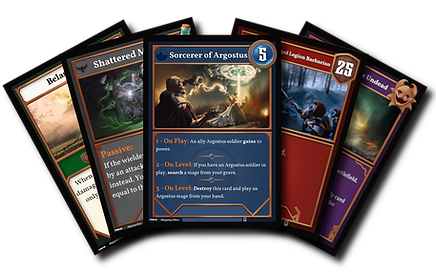
To start, let's have a look at the kinds of cards you will be using to achieve this.

Castles
Castles are the heart of Castle Wars. Castles represent a player's health. They also dictate what a player may have on the field at one time, and have their own abilities.
-
Castle cards are distinguished by the Heart Gem icon at the bottom of the card.
-
The number on the icon represents its starting health.
-
When a player’s Castle Health reaches 0, they lose.
-
Castles cannot be removed from the battlefield in any way.
-
Each castle places a limit on the number of cards you can control on the battlefield. This is called the Garrison Capacity. You may only control cards up to the number of symbols of the specified card types of your garrison capacity (e.g. the Argostus University has a garrison capacity of 2 soldiers, 3 mages and 2 tricksters).
-
Some castles feature half-and-half symbols in their garrison capacity; this means either of the depicted card types can be played to count towards that garrison slot (but not both at once).
Soldiers
Soldiers act as your main form of attack and defense on the battlefield.
-
Soldier cards are distinguished by the Shield icon in the top right-hand corner of the card.
-
Inside this icon, you will find a power level which signifies that this card is capable of declaring an attack (more on this later).
-
Soldiers can have 1 or more abilities, which can be found in the text box below the artwork.
-
Soldiers defend castles from other soldiers’ attacks. In other words, all enemy soldiers must be destroyed before an ally soldier can target an enemy castle for an attack.
-
Each soldier can attack once per turn, at any point during your turn.


Mages
Mages offer a more supportive presence on the battlefield, but over time, they can be built up to become a formidable force in their own right.
-
Mage Cards are distinguished by the crystal ball icon in the top right-hand corner of the card.
-
Like soldiers, mages have a power level contained within this icon, signifying that they, too, are capable of declaring an attack.
-
Mages have 3 abilities, each corresponding to a level found in the text box below the artwork.
-
When played, they start at level 1. But you can level up your mage(s) once per turn, excluding the turn they were played.
-
Mages may only use the ability which corresponds to their current level.
-
Only level 3 mages can attack. These mages can attack the castle directly regardless of whether there are soldiers on the enemy’s side of the battlefield.
-
Mages do not defend the castle from attacks. However, they can still be chosen as attack targets by enemy soldiers and mages.
Tricksters
Tricksters are single-use cards that offer powerful abilities which aim to disrupt your enemy.
-
Trickster Cards are distinguished by the Jester icon in the top right-hand corner of the card.
-
Tricksters can only be played face down and are only flipped faced up when they are being activated in response to a specified action, known as it’s “trigger”.
-
More than 1 Trickster can be activated, or “sparked” at the same time in response to a single action.
-
If your trickster zones are full but you wish to play another trickster from your hand, you may destroy one trickster in your trickster zones (without sparking its ability) to play another one from your hand.


Items
Items are cards which provide additional abilities when wielded by soldiers or mages.
-
Item cards are distinguished by the potion icon in the top right-hand corner of the card.
-
Items must first be played (i.e. wielded) under an ally soldier or mage.
-
A soldier or mage can only wield 1 item at a time. If a soldier or mage is currently wielding an item, it may not wield another.
-
Item cards must be wielded by a soldier or mage to remain on the battlefield. If the current wielder of an item is removed from the battlefield (in any way), the item is destroyed.
-
There is no limit on the number of item cards you can play per turn.
Factions



In the top left-hand corner of each non-castle card and the card text background, you will find a crest which corresponds to a card's Faction (also indicated by the card’s colour). A faction is a special grouping in Castle Wars which denotes the kingdom the depicted character belongs to in the lore. Some cards have abilities that specify their Faction in the text. The red cards with the bear crest are in the Silas faction. Blue cards with the mountain crest are a part of the Argostus faction. Green cards with the scale crest are in Belaste. Purple cards with the serpent and dagger crest are in Calostan. Lastly, grey cards with bird crests are Rogues who do not belong to any faction.
Deck
-
A deck must contain exactly 50 cards.
-
A deck may not contain more than 3 copies of any specific card.
-
You may have a “Side” Deck of up to 10 cards. These may be swapped into the deck between games in a “best of” match set, as long as the deck number remains 50.
-
The castle card is not included in the number of cards in the deck and is kept separate from the deck. You may have additional castles in your side deck, but they will count towards the 10-card limit in this instance.
Game Layout

The main playspace is set up as pictured below. The area of play can be separated into 4 distinct locations: the Deck, the battlefield, the Grave, and the Player Hand.
-
The Battlefield consists of the 10 zones in the centre of the playspace. You will notice that on official Castle Wars gaming mats, these zones can be distinguished by the symbols within their borders. This is to distinguish the type of card that may be played into these zones. The Battlefield has 3 zone types.
The top row of the battlefield is known as the Frontline. This is where cards which are capable of attacking your enemy, i.e. soldiers and mages, can be played.
In the row behind this, you will find your Trickster and Castle zones. As the names suggest, this is where you may play trickster and castle cards. The castle zone is found in the middle of this row, and your trickster zones are the four zones on either side of your castle zone. -
The Player’s Deck will be placed on the zone located to the right of the battlefield, known as the Deck zone.
-
The Grave Zone is the zone located to the left of the battlefield. Cards that are destroyed or discarded are placed here.
-
Items do not have a zone of their own; instead, they are placed underneath the card they are wielded by on the battlefield.
Main Rules

To start, let's have a look at the kinds of cards you will be using to achieve this.
Beginning of a battle
At the start of a battle, both players place their castles face down in their castle zones and roll to see who goes first. They then shuffle their decks.
Whenever a player shuffles their deck, their opponent has the option to cut/shuffle the deck afterwards. Then each player draws 6 cards. At this point, either player may call a single mulligan, where they can choose cards to shuffle into their deck and draw until they have 5 cards. Once all mulligans have been completed, flip your castle cards, and the first player may start their turn.
Drawing
At the start of each turn, except for the first player’s first turn, the turn player must draw 1 card from their deck. Your hand size must not exceed 7 cards by the end of your turn. If at the end of your turn your hand size exceeds 7 cards, you must discard cards until your hand size reaches exactly 7 cards.
Turn Flow
Unlike many other trading card games, there are no “phases” in Castle Wars. So you may take actions in any order until you either run out of actions or no longer wish to proceed with your turn.
Playing Cards from Hand
Each turn, 1 soldier, 1 mage, and 1 trickster may be played as long as doing so would not exceed your garrison capacity.
Cost
Some cards have a cost, indicated by a box at the bottom of the card. The cost refers to cards that must be destroyed from your field to play the card from hand/deck/grave. This cost must always be paid before the card hits the battlefield, even if it's played by an ability.
You cannot play a cost-card if there is no space on the board due to your castle’s garrison capacity, unless the cost of playing would make the required space.
Searching
Whenever a card requires you to search your deck in any way, the deck must be shuffled afterwards.
Abilities
During your turn, you also get the opportunity to activate or spark the abilities of your cards. When sparking abilities, the ability must be completed as much as possible as you read it (resolving left to right). As soon as there is a part of an ability that cannot be done, the rest of the ability is cancelled and cannot take place.
Sparking an ability is optional; however, if you choose to spark an ability, it must attempt to resolve in its entirety.
Chain of Command

When 2+ abilities are sparked simultaneously or in response to each other, they are placed on a Chain of Command (CoC).
Chains of command always resolve backwards. The turn player’s simultaneous abilities are always placed on the CoC first, in the order of their choosing. Then, the next opposing player has the chance to respond with abilities that trigger during the specified period. Next, the turn player/next ally player has a chance to respond to those abilities with their own abilities that occur in the specified period. The players will then go back and forth declaring responsive abilities until there are no more to declare, at which point the CoC will resolve starting from the final declared ability backwards to the first ability in the CoC.
Example 1: Simultaneous abilities.
If a player has multiple effects to resolve simultaneously, they get to choose the order in which those abilities resolve on the CoC:
If Player A declares an attack with a Vicious Armoured Hound wielding a Bloodied Battle Horn on an enemy mage, both On-Attack effects would spark simultaneously. In this case, the turn player can decide the order of their CoC. Remember, the CoC resolves backwards, so if Player A decides to place Vicious Armored Hound’s own ability second on the CoC, it would first double its power to 20, and then it would gain an additional 10 from Bloodied Battle Horn. If, however, Bloodied Battle Horn were to be placed second on the CoC, then Vicious Armoured Hound would first gain 10 power and then its power would double, giving it 40 power!
Example 2: Responsive abilities
Player A makes an action which triggers one of Player B’s cards’ abilities in response,
If Player A sparked Meditating Shaman and then, in response, Player B sparked The Jester’s Jester, the CoC will resolve backwards. This means that The Jester’s Jest ability to cancel another trickster’s ability would resolve before Meditating Shaman’s ability. As a result, Meditating Shaman’s ability does not resolve, but as it was still sparked, it goes to the grave.
Ability Types
There are 4 types of abilities: Action-based, location-based, Triggered and Passive abilities.
Action-based Abilities
Action-based abilities are abilities that are sparked when a specified action occurs. Action-based abilities are always written in two parts, the prefix and the action itself.
Starting with the latter, an action is a term that refers to the ways in which a card can be used during a turn. For instance, you could:
-
Play a card on the battlefield from another location.
-
Attack with a card
-
Discard a card from the hand to the grave.
-
Draw a card from the deck to hand.
(A full list of actions can be found in the glossary.)
Moving to the former, the prefix of the ability denotes the time at which the ability can be sparked. All actions are completed in two stages. The pre-action stage occurs when an action is declared, but before that action takes place. The on-action stage occurs whilst the action actually occurs. There are 2 prefixes corresponding to these two stages for you to familiarise yourself with:
-
“Pre” denotes abilities that are sparked on the declaration of an action, but before that action takes place.
-
“On” denotes abilities that are sparked on the resolution of an action, i.e. simultaneously with that action taking place.
Example 1. Pre-attack abilities spark when a player declares an attack on an opponent’s card with one of their own, but before that attack occurs. On-attack abilities spark whilst that attack occurs.
Different types of action-based abilities cannot be triggered at the same time, i.e. on the same CoC. If two different kinds of action-based abilities are triggered, the first has to attempt to fully resolve before the second one is triggered.
Example 2: If Reylt the Threatening Mercenary discards Sacrifice of Belaste as part of its ability to play a Silas Soldier, its ability must attempt to resolve in its entirety before Sacrifice of Belaste’s on-discard effect to play itself triggers, i.e. a Silas soldier must be played.
Location-based Abilities
Location-based abilities can be sparked during your turn between actions. The card must be in the specified location to spark the ability. As mentioned in the Game layout section of this Rulebook, there are 4 locations to familiarize yourself with, which correspond to the 4 location ability types:
-
Deck abilities can be sparked while a card is in the deck.
-
Hand abilities can be sparked while a card is in hand.
-
Battlefield abilities can be sparked while a card is on the battlefield
-
Grave abilities can be sparked while a card is in the grave.
N.B. As location-based abilities can only be sparked between actions, they cannot be sparked simultaneously with action-based abilities. If a location-based ability triggers an action-based ability, the location-based ability must resolve as much as possible first and then a new chain is started for the Action-based ability.
Example. Sacrifice of Belaste has Call of the Flag equipped and uses its Battlefield ability to destroy itself to draw a card. This triggers Call of the Flag’s on-destroy ability. As location-based and action-based abilities do not spark simultaneously, Sacrifice of Belaste’s ability to draw must resolve, and then Call of the Flag starts a new chain to search for a no-cost Silas soldier.
Trigger
Trigger abilities are abilities that are sparked in response to another card making an action. As all actions take place in two stages, trigger abilities have their own key phrases to specify the time at which they can be sparked. If a trigger says that it will spark before a specified action, then it happens on the declaration of an action, simultaneously with “pre” Action-based abilities. If a trigger says that it will spark when an action takes place, then it will happen on the resolution of that action, simultaneously with “on” action-based abilities.
There is, however, a special category of action that can trigger this kind of ability: sparking. Sparking is the only action that can occur simultaneously with other actions, as sparking simply denotes the activation of abilities, and certain types of abilities can be activated simultaneously with actions. This means if an ability says it triggers when a certain type of card sparks its ability, it can be placed on the same CoC as an ability of the specified card type, regardless of the action that caused the ability.
Example 1: The Jester's Jester can trigger when a trickster's ability is sparked. This means it could be triggered in response to Surprise Counter being sparked, as Surprise Counter is a trickster. As Surprise Counter is triggered in response to an attacking action, and The Jester’s Jester can respond to Surprise Counter, it is considered as occurring in the same action stage and thus a part of the same CoC.
Passive
Passive abilities are abilities that apply continuously while the card is face up on the field, regardless of the turn. If the card is removed from the field, its passive ability is cancelled.
N.B. If there are two contradicting passives on the battlefield at the same time, the passive that was sparked first takes priority.
Internal Turn Count

Internal turn count
A card's internal turn count, that is number of turns a card has occupied a given location (field, hand, deck or grave), is counted from the moment it occupies that location until the moment it leaves that location. This can lead to some interesting interactions. Most commonly, if you have a level 3 mage that leaves the field and then is played again, it starts again at level 1, and thus, its level 1 abilities apply.
Once-per-turn actions like attacking can also be reset in this way. So you can attack with a soldier, and if it is returned to your hand, you can play it again and attack once more with it. This is because the card is only seen as having just started its first turn on the field, whether or not it had been on the field previously before being removed.
Similarly, location-based abilities are reset the moment the card leaves the location specified in the ability. So, if you activate and in-hand ability, remove that card from your hand (perhaps by playing it), and then it is returned to your hand, you can activate that ability once more.
N.B.: Moving zone does not reset a card's internal turn count. We can draw a distinction between zones and locations:
Locations (e.g. hand, battlefield, deck) refer to distinct areas within the play space. Cards in the same location can be interacted with in the same way, whereas cards in distinct locations are interacted with differently. For instance, cards in the deck can be searched or drawn. Cards in the hand can be discarded or played without the use of an ability. Cards on the battlefield can be destroyed and may attack. Cards in the trickster zone are triggered. Cards in the grave cannot be interacted with without sparking an ability.
Zones refer to the different areas a card can occupy within a given location. As such, a card moving zones in the battlefield without leaving the frontline does not reset its internal turn count, as whilst it has moved zones, it is still considered to be in the same location.
Attacking
The player who goes last is the first that is allowed to attack, and from then on, all players may attack during their turn. All cards in your battlefield can attack once during your turn. Soldier cards may choose whether to attack a soldier, a mage, or, if the enemy has no soldiers, the enemy castle directly. Mages may only attack once they reach level 3. Like soldiers, mages may attack enemy soldiers or mages, but, unlike soldiers, they may also attack the castle directly, regardless of soldier presence.
To attack, you must declare which card is attacking and its attack target. If the attack target is a card in the enemy frontline, you must compare the power levels of the two cards. The card with the higher power wins, and the lower gets destroyed. If both cards have equal power, both get destroyed. Destroyed cards are placed in the grave of their original owner.
If a castle is attacked, its health decreases by the power level of the attacking card.
If a card declares an attack on a specified target and that target is then removed from the field before that attack occurs, the attack will still attempt to resolve, but as there is no designated target, it will fail. The attacker is still considered to have used their one attack for the turn, as the attack was attempted.
Attacking action stages
Attacks can be considered as occurring over four action stages.
-
The attack declaration or pre-action stage. This is when you declare an attack with a card and its attack target.
-
The attack resolution, or on-action stage. When the attack occurs.
-
The damage calculation / pre-destruction stage. This is when the results of the battle are tallied, cards are designated for destruction, and the damage that is to be applied to the castle is calculated.
-
The battle resolution or the on-destruction stage. This is when the damage is applied to the castle, and cards are destroyed and are considered as having moved to the grave.